How We Made Manggis: A Dad, His Son and an Angry Mangosteen
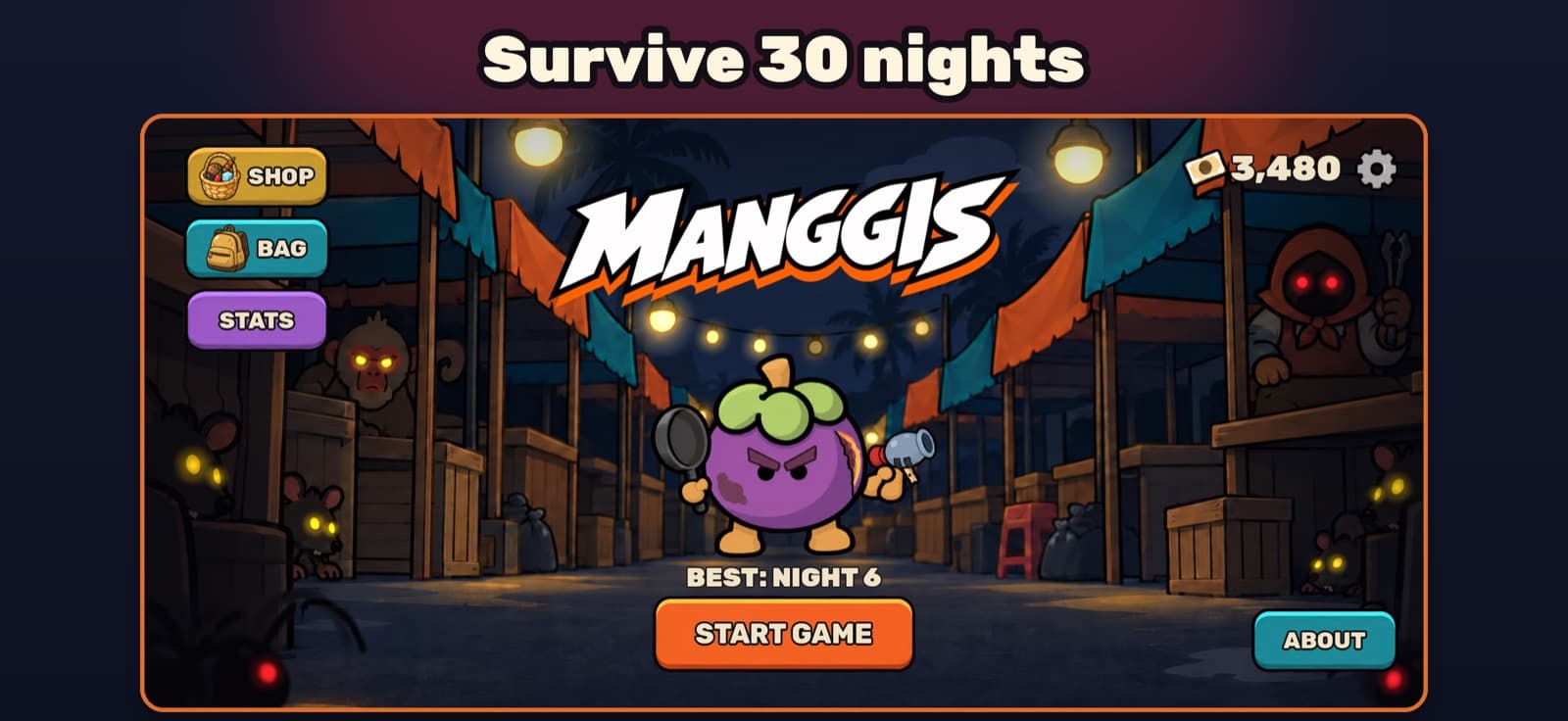
Manggis is a free iPhone and iPad game about an angry mangosteen that nobody bought. The night market has closed, and the fruit has to survive thirty nights of rats, ants, macaques and ten bosses with a bottle blaster and a frying pan. The first line of code went in on September 13, 2026. Version 1.0 was on the App Store on October 8.
This is how we made it: where the idea and the name came from, what Nikita did, and the exact setup we used.
Where the idea and the name came from
We live in Bali, and in Indonesian and Malay a mangosteen is a manggis. That is the game's name and the hero's name.
The angry fruit was Nikita's idea. The very first spec, written on day one, pitched it in two sentences: a bruised, angry mangosteen left unsold at a Southeast Asian night market in 1997, and you have to survive the nights. For the first two days the project and the hero were called Sisteen. On September 15 we renamed both to Manggis. The project folder on my computer is still called Sisteen.
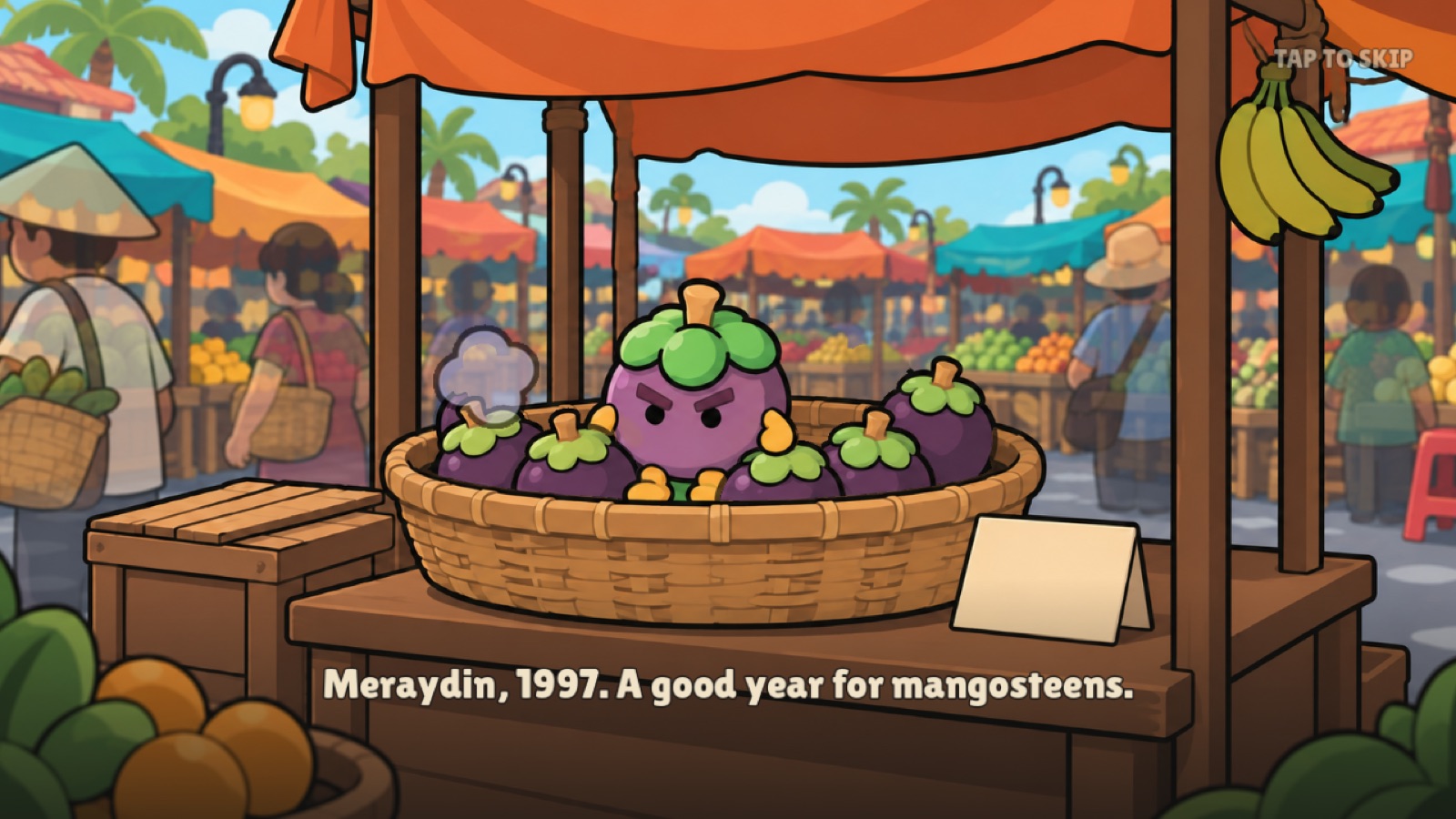
The market is in Meraydin, the same made-up 1997 port as our other game, Meraydin: Merge Cargo. The comic intro opens with one line: "Meraydin, 1997. A good year for mangosteens."
Day one: circles
On the first day there was no art at all. The mangosteen was a purple circle, the rats were brown circles, and the shots were dots. You could already move, the blaster fired by itself, the pan swung and the rats came at you. By the evening the prototype held 300 enemies on screen at 60 frames per second.
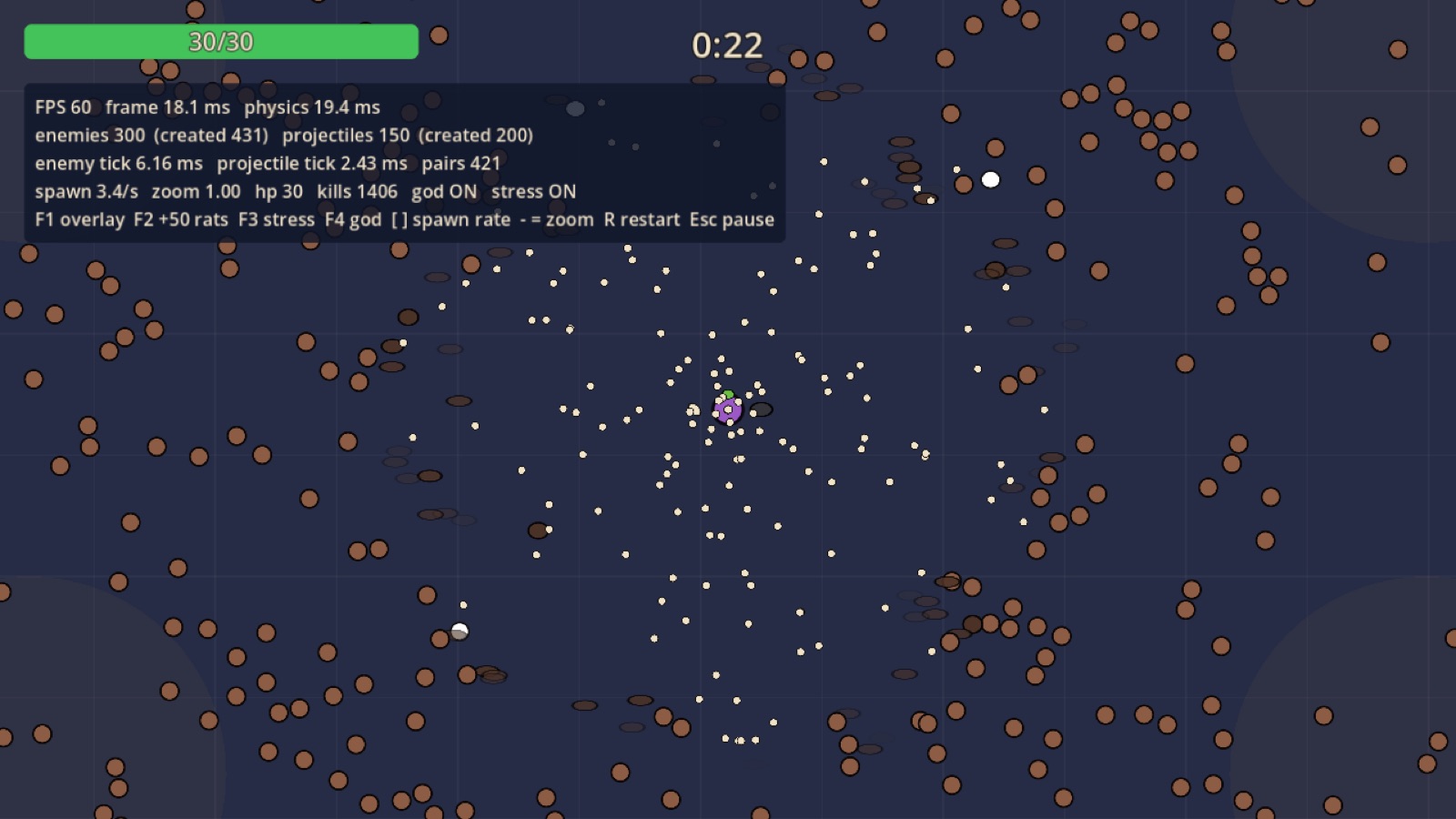
The first commit also had a target picture of what a finished night should look like.
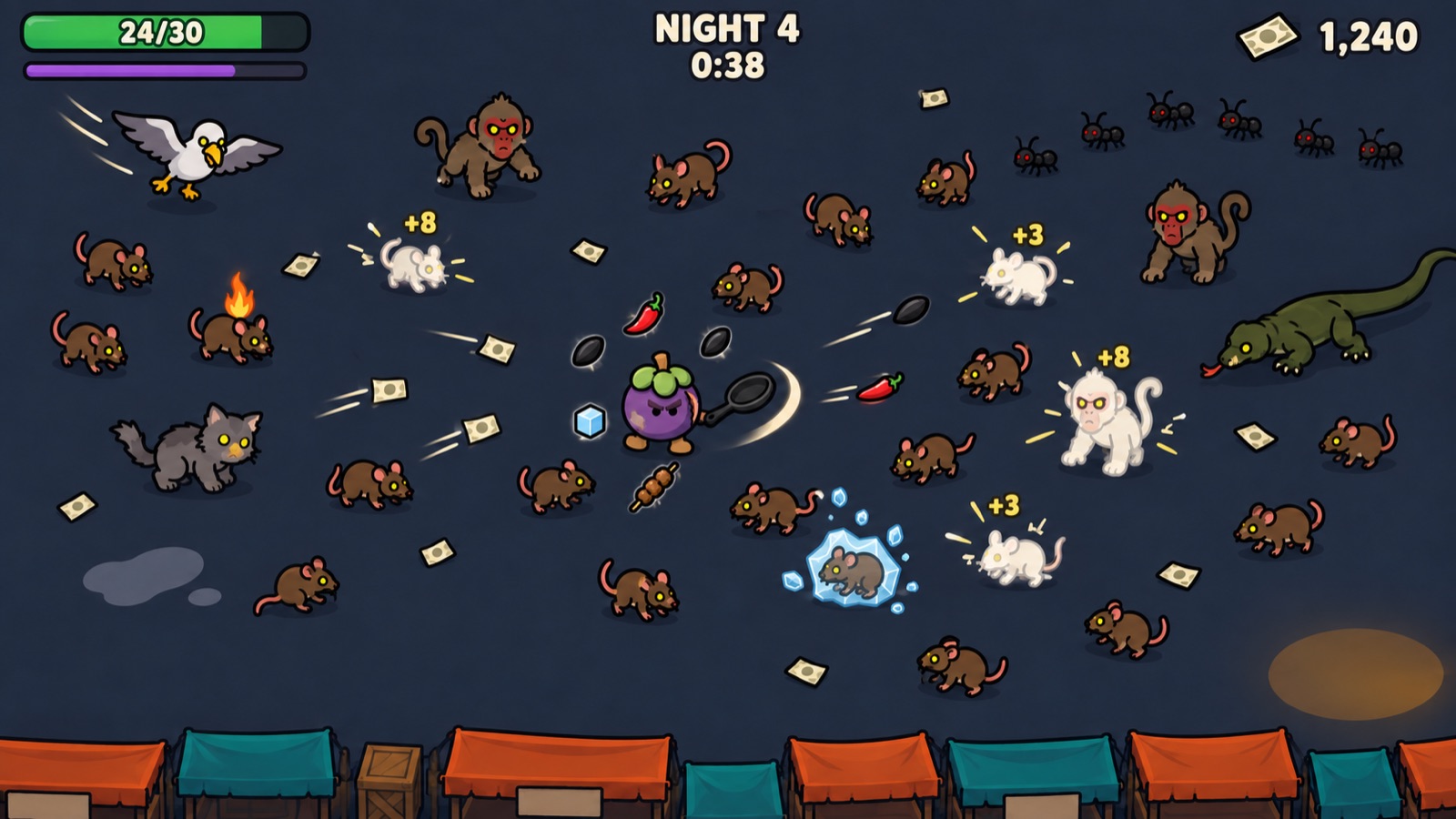
Nikita's job: play every build
Nikita tested the game the whole way through. He played the builds again and again and kept telling us which bosses the game should have. In the credits his title is Concept & Critic.
Playtest notes were short and blunt. After the September 19 playtests two of them were that the rounds were too short at 30 seconds, and that all the enemies moved at the same speed. Both turned into changes. We uploaded 30 builds in total.
If you want to make a game with your kid, give them this job. Playing the builds and saying what to change is real work on a real game.
Ten bosses, thirty nights
The first version had one boss: the Market Auntie, on night 20. On October 1 we rebuilt the run around thirty nights with a boss every third night, and each boss grew out of the enemies already in the game.
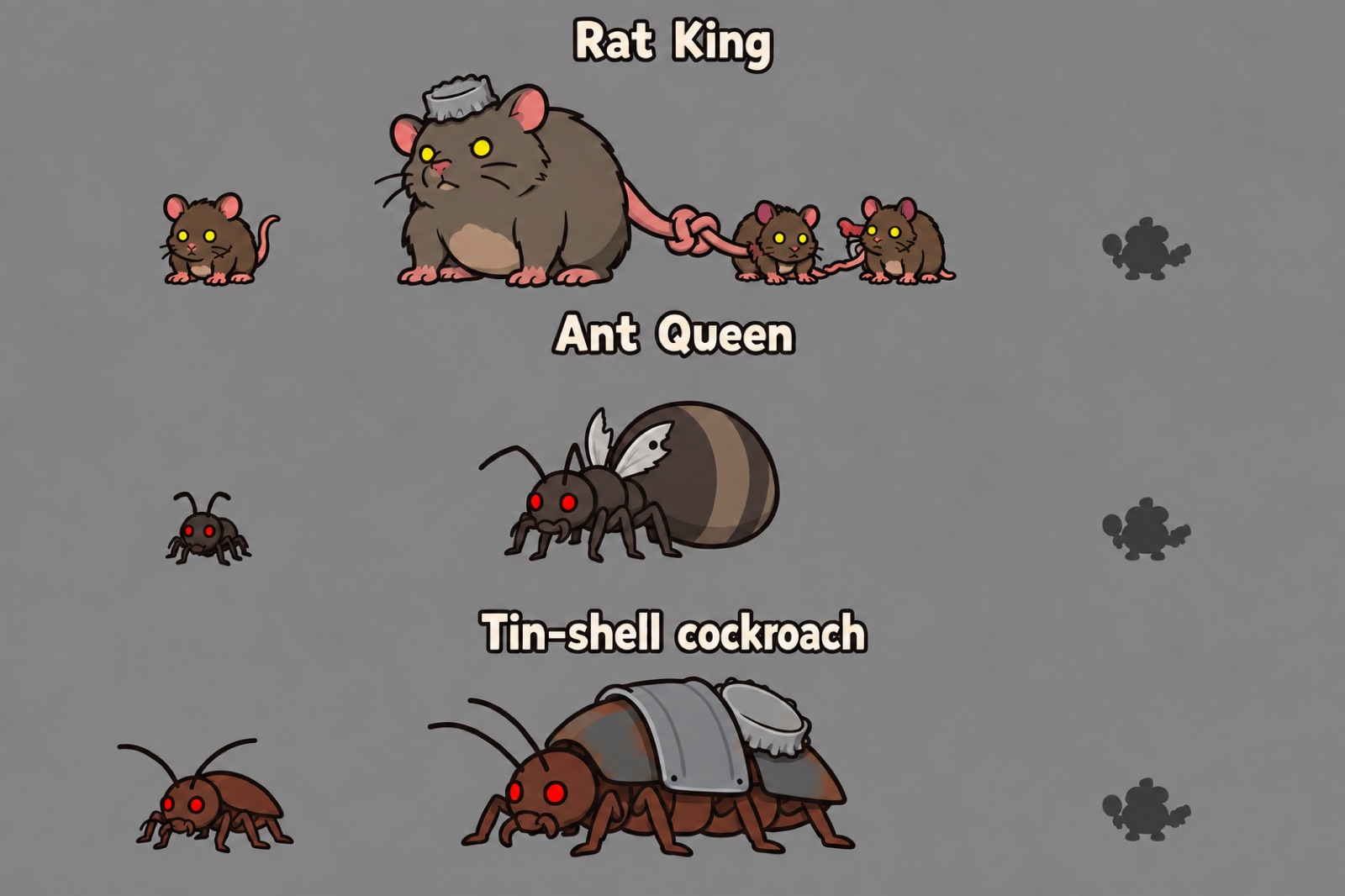
| Night | Boss | What it does |
|---|---|---|
| 3 | Rat King | Charges at you and calls more rats |
| 6 | Ant Queen | Comes out of an ant hole and sends columns of ants |
| 9 | Tin Cockroach | Armoured shell, splits in two at half health |
| 12 | Alley Queen | Hates water and stalks along the stall roofs |
| 15 | Macaque Chief | Catches your shots and throws them back |
| 18 | Great Gull | Steals your banknotes |
| 21 | Pack Leader | Gets tougher with every dog in the pack |
| 24 | Old Monitor | Venom puddles, eggs that hatch, a tail sweep |
| 27 | Scrap King | Bounces off the walls, drops mines, brings runners |
| 30 | Market Auntie | Basket trap, tongs, and she flips her cart |
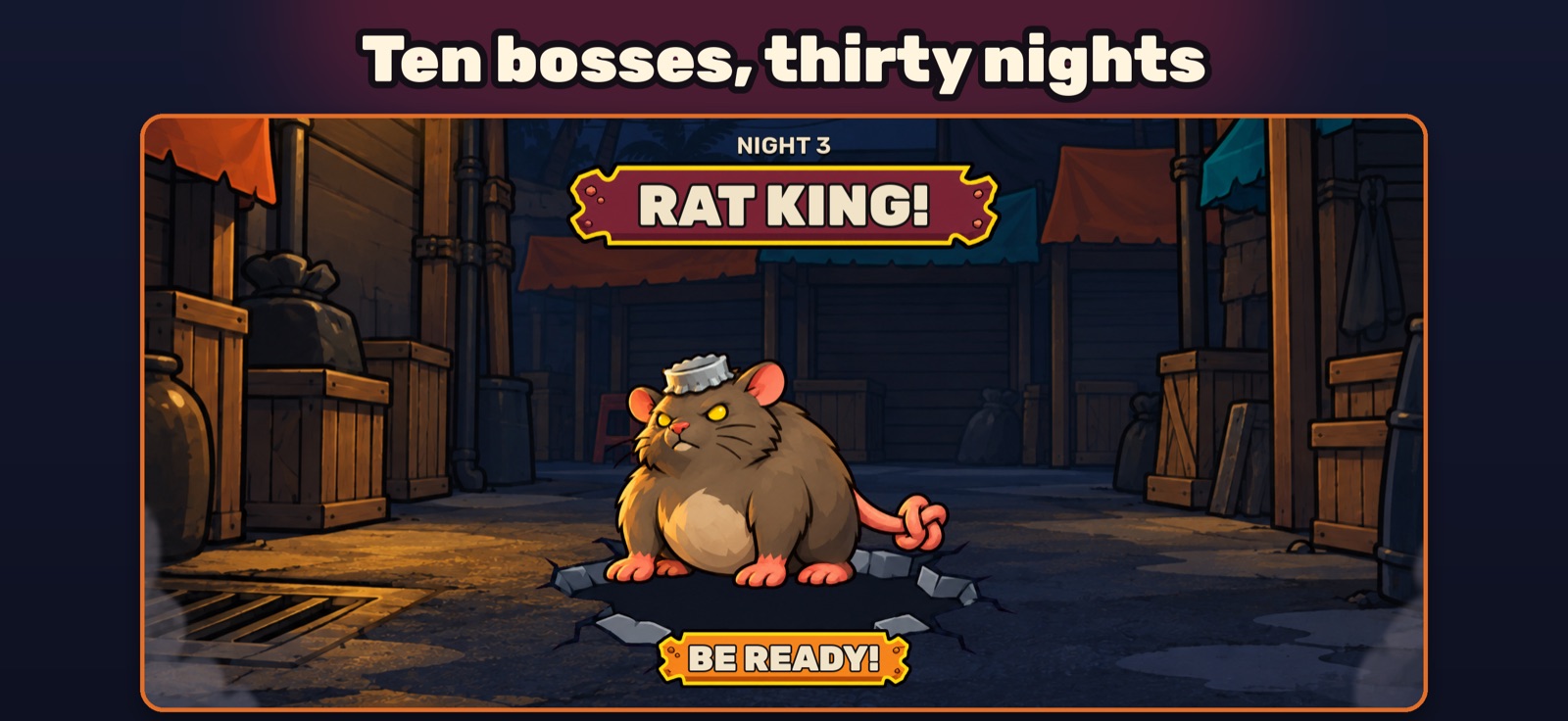
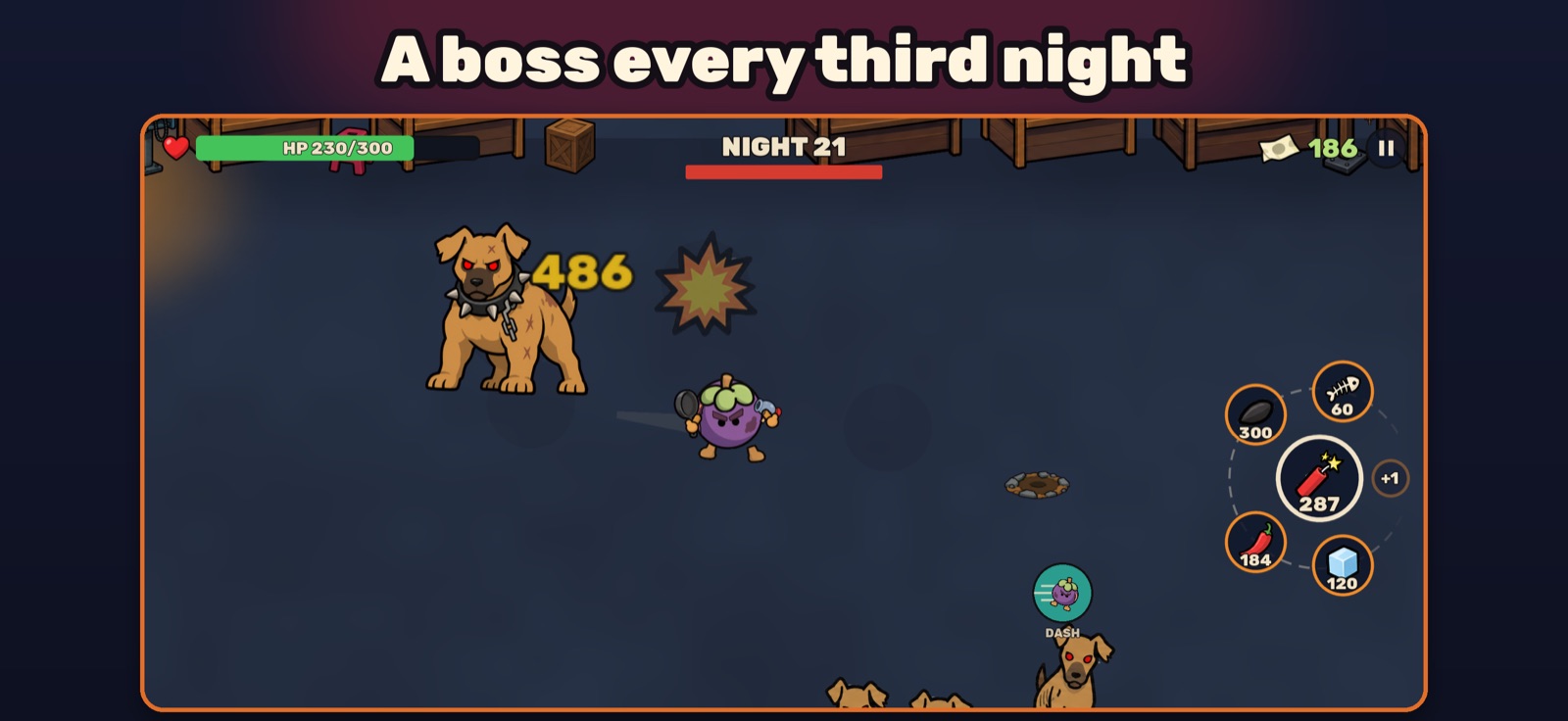
The first update, version 1.1, was all about the bosses: every boss now fights in its own way.
Our setup
This is everything we used, in one place.
| Part | What we used |
|---|---|
| Engine | Godot 4.7, GDScript with static types, the mobile renderer |
| Code | Claude Code. The code credit in the game says "Claude" |
| Running the game for the AI | Godot MCP Pro, so Claude can start the game, take screenshots and press buttons |
| Tests | 185 automated tests, a screenshot harness and a bot that plays whole runs to check the balance |
| Art | Early art including my own drawings, then GPT Astra from October 1 |
| Music | Generated with Suno v6, credited to our band name, Boon Band |
| Sound effects | Kenney (CC0), the Sonniss GDC bundle, Suno Sounds, and one frying pan I recorded myself |
| iOS parts | Small Swift plugins for haptics, in-app purchases (StoreKit 2), Game Center with iCloud saves, and Firebase |
| Test phones | iPhone 14 Pro Max; the oldest phone we target is the iPhone 13 |
| Languages | 10: English, Russian, Ukrainian, Spanish, Brazilian Portuguese, German, French, Japanese, Korean, Indonesian |
How the code got written
I wrote down what the game should be in one long spec file, and Claude Code wrote the code from it. Every rule in that file has the reason next to it, so the next session knows why a decision was made and doesn't undo it. Several Claude sessions often worked at once, each in its own copy of the project (a git worktree).
A separate playtester agent runs the game and reports numbers: how many enemies are on screen and how many frames per second the phone keeps up. One rule it never breaks: it never says a night feels right. That call was always made by a person, on a real phone.
How the art got made
GPT Astra is an OpenAI Codex agent with image generation. It drew the bosses, enemies and items as sprite sheets on a flat magenta background. Claude checked each sheet, cut it into separate sprites and put them in the game. The style rules (thick dark outline, flat colours, a little grime) live in one file that Astra reads before every task, so every sheet comes out in the same style.
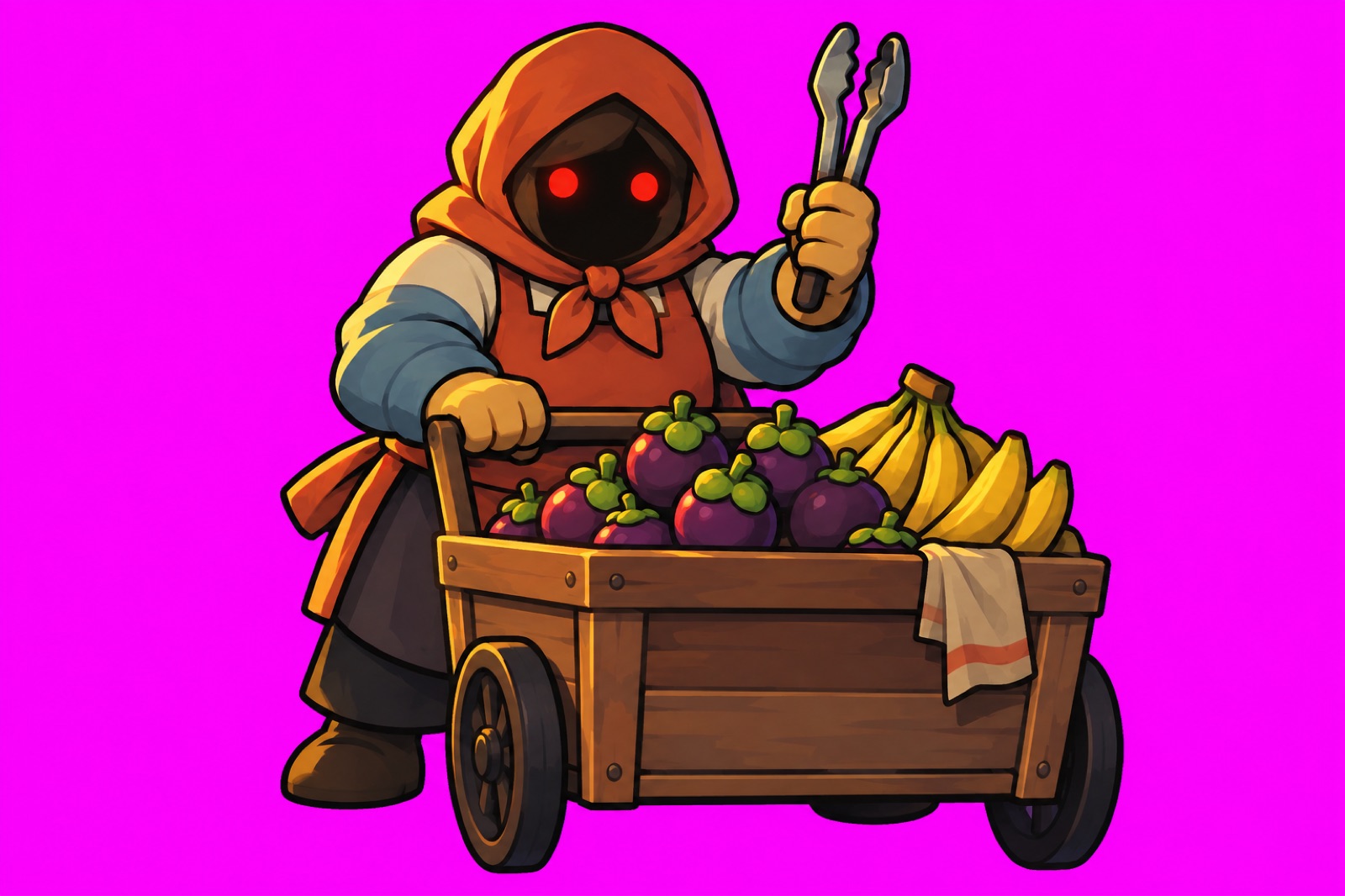
Four weeks, day by day
- September 13. First code. Circles on a screen, 300 enemies at 60 FPS.
- September 15. Sisteen becomes Manggis.
- September 19. The first playtests. The music is generated the same day.
- September 20. Build 1 on TestFlight. The comic intro and the first boss.
- September 24. Version 1.0 is feature-complete.
- October 1. Thirty nights and ten bosses. GPT Astra draws its first sheet. We fix the screenshot Apple rejected our first submission for: it showed a price.
- October 7. iPad support.
- October 8. Manggis 1.0 is live on the App Store.
- October 9. Version 1.1 goes to Apple: every boss fights its own way.
Play it
Manggis is free on the App Store for iPhone and iPad. The Manggis page has the trailer and more screenshots. We film our games and playtests on our YouTube channel. Tell us in the comments which night you reached.